

What Is Keyword Difficulty? How to Find SEO Keywords You Can Actually Rank For

Every successful SEO strategy starts with choosing the right keywords—but not every keyword is worth targeting. According to multiple industry studies, over 90% of web pages receive little or no organic traffic from Google, often because they target highly competitive keywords without considering their ability to rank. Even the most well-written content can struggle to reach the first page if the target keyword is beyond a website's current authority and SEO strength.
This is where keyword difficulty becomes one of the most important metrics in keyword research. It estimates how challenging it may be to rank for a specific search term by evaluating the competition already occupying Google's search results. Understanding what keyword difficulty is in SEO helps marketers, businesses, and content creators focus on keywords that offer realistic ranking opportunities instead of wasting time competing for terms dominated by authoritative websites.
However, a keyword difficulty score shouldn't be viewed in isolation. Search intent, content quality, topical authority, backlinks, and website credibility all influence your ability to rank. Learning how to check keyword difficulty and interpret it correctly allows you to build a smarter SEO strategy that balances competition with opportunity.
In this guide, you'll learn what keyword difficulty means, how it is calculated, how to use a free keyword difficulty checker effectively, common mistakes to avoid, and practical strategies for finding SEO keywords that your website can realistically rank for. Whether you're a beginner or an experienced SEO professional, this guide will help you make more informed keyword decisions and improve your chances of earning sustainable organic traffic.
Key Takeaways
- Keyword difficulty helps you estimate how challenging it will be to rank for a specific keyword, allowing you to focus on realistic SEO opportunities.
- Always compare keyword difficulty with search volume, search intent, and your website's authority before selecting target keywords.
- Analyzing the top-ranking pages reveals why competitors rank and what your content needs to outperform them.
- Choosing achievable keywords with the right balance of competition and traffic can deliver faster rankings and sustainable organic growth.
- Using a reliable keyword difficulty checker helps you identify high-potential keywords, prioritize your SEO strategy, and make data-driven decisions
What Is Keyword Difficulty in SEO?
Imagine you've spent days researching a topic, writing a detailed article, optimizing every heading, and publishing it with high expectations. Weeks later, your page is still buried on page 3 or 4 in Google search results, while competitors continue to dominate the top results.
The problem often isn't your content—it's the keyword you chose.
This is exactly where keyword difficulty becomes one of the most valuable metrics in SEO.
Keyword difficulty estimates how challenging it is to rank for a specific search term in Google's organic search results. It helps you understand the level of competition before you invest your time and resources into creating content. Instead of guessing whether a keyword is achievable, you can evaluate its ranking potential based on the strength of the pages already occupying the first page of Google.
For example, imagine you own a new digital marketing website and want to rank for the keyword "free SEO tools." Although it attracts thousands of monthly searches, the first page is dominated by well-established brands with years of authority, thousands of backlinks, and extensive content libraries. Competing against them immediately would be extremely difficult.
Now compare that with a more specific keyword like "free keyword difficulty checker." While it may have a lower search volume, it usually has more focused search intent and often presents a realistic opportunity for newer or growing websites. By choosing keywords that align with your website's authority, you increase your chances of earning rankings, attracting qualified visitors, and building long-term organic growth.
However, keyword difficulty in SEO should never be viewed as the only deciding factor. A keyword with a low difficulty score isn't automatically the best choice if nobody is searching for it or if it doesn't match your audience's intent. Likewise, a higher-difficulty keyword can still be worth targeting if it aligns with your long-term content strategy and your website has the authority to compete.
The best SEO strategies evaluate keyword difficulty alongside other essential metrics, including:
- Search volume to understand demand.
- Search intent to ensure your content matches what users expect.
- Topical relevance to strengthen your website's authority.
- Competition on Google's first page to measure ranking difficulty.
- Business value to attract visitors who are more likely to convert.
This balanced approach helps you choose keywords that are not only easier to rank for but also capable of driving meaningful traffic and business results.
A Practical Example for the Keyword Difficulty
Suppose you're planning to publish a guide about improving website performance.
You discover two potential keywords:
- Core Web Vitals – High search volume with strong competition from authoritative websites.
- Website Core Web Vitals Checker – Lower competition, clearer user intent, and a better opportunity for a growing website.
If your website is still building authority, targeting the second keyword gives you a much higher chance of reaching the first page. Once you've established topical authority and gained stronger rankings, you can gradually target broader, more competitive keywords.
This is exactly why experienced SEO professionals don't choose keywords based only on popularity; they choose them based on ranking opportunity.
As your SEO strategy evolves, combining keyword difficulty, website SEO analysis, on-page optimization, and keyword rank tracking allows you to build sustainable growth instead of chasing keywords that are unlikely to deliver results. The goal isn't simply to target the easiest keywords; it's to find the keywords your website has the greatest potential to rank for today while creating a path toward more competitive opportunities tomorrow.
Why Keyword Difficulty Is Important in Digital Marketing
Choosing the right keywords can determine whether your content becomes a consistent source of organic traffic or gets buried beneath thousands of competing pages. In digital marketing, success isn't measured by publishing more content; it's measured by publishing content that has a realistic chance of ranking. That's why understanding keyword difficulty in digital marketing is essential for businesses, marketers, and SEO professionals who want to maximize their return on investment.
Many websites make the mistake of targeting keywords simply because they have high search volume. While these keywords may seem attractive, they're often dominated by well-established brands with years of authority, strong backlink profiles, and extensive topical coverage. Competing against them without evaluating the competition can lead to months of effort with little or no improvement in rankings.
By checking keyword difficulty before creating content, you can identify opportunities that match your website's current authority. Instead of competing for impossible keywords, you focus on search terms where your content has a genuine chance of reaching the first page of Google. This approach helps you achieve faster SEO wins while steadily building your website's credibility over time.
Why Does Keyword Difficulty Matter in Digital Marketing?
Understanding keyword difficulty helps you make smarter decisions throughout your SEO strategy. It allows you to:
- Prioritize keywords that offer the best balance between search volume and ranking potential.
- Allocate your content and marketing efforts where they can generate the highest return.
- Build topical authority by ranking for achievable keywords before targeting highly competitive terms.
- Reduce time and resources spent creating content that is unlikely to rank.
- Develop a long-term SEO strategy based on data instead of assumptions.
For example, imagine two businesses launch similar blog articles. One targets an extremely competitive keyword without researching its difficulty, while the other uses a free keyword difficulty checker to identify a lower-competition keyword with strong search intent. Although the second keyword may attract fewer monthly searches, it often reaches Google's first page much sooner, generating qualified traffic and creating opportunities to rank for broader topics in the future.
This strategy is especially valuable for startups, local businesses, freelancers, and growing websites. Rather than competing with industry giants immediately, they can establish authority by consistently ranking for relevant, lower-competition keywords. As their website gains backlinks, topical relevance, and user trust, they become better positioned to target more competitive search terms.
Ultimately, keyword difficulty isn't about avoiding competition—it's about competing strategically. When combined with keyword research, website SEO analysis, on-page SEO optimization, and ongoing Google keyword rank tracking, it becomes one of the most reliable ways to build sustainable organic growth. Every successful SEO campaign begins with choosing the right opportunities, and keyword difficulty helps you identify exactly where those opportunities exist.
Don't choose a keyword based only on its search volume. Always evaluate its difficulty, search intent, and business relevance together. The best keyword isn't necessarily the most searched one; it's the one your website has the highest chance of ranking for while delivering meaningful traffic and conversions.
How Is Keyword Difficulty Calculated?
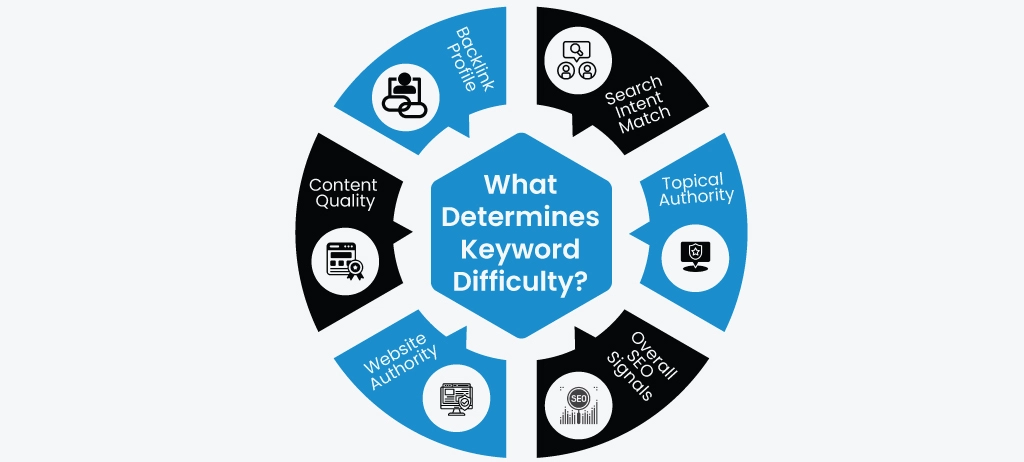
When you use a keyword difficulty checker, the score doesn't come from a single factor. Instead, it is calculated by analyzing multiple SEO signals that help estimate how difficult it may be to outrank the pages already appearing on Google's first page.
Every SEO tool uses its own method, so the exact score may vary from one platform to another. However, most tools evaluate similar ranking factors to measure the level of competition for a keyword. Understanding these factors helps you make better decisions instead of relying on the difficulty score alone.
Let's look at the main factors that influence keyword difficulty.
Authority of the Ranking Websites
One of the biggest factors is the authority of the websites already ranking for the keyword. If the search results are filled with trusted websites that have built their reputation over many years, ranking against them becomes much harder.
For example, if the first page is dominated by websites like Google Search Central, Semrush, or Ahrefs, a new website will need much stronger content and authority to compete.
Quality of the Existing Content
Google doesn't rank pages just because they use the right keywords. It rewards content that answers users' questions better than other pages.
If the top-ranking articles are detailed, well-structured, regularly updated, and provide real value, your content must be even more useful to earn a higher position.
This is why creating quality content is just as important as choosing the right keyword.
Backlink Strength of the Keywords
Backlinks remain one of Google's strongest ranking signals.
When the pages ranking for a keyword have hundreds of high-quality backlinks from trusted websites, the keyword usually becomes more competitive. On the other hand, if the top-ranking pages have only a few backlinks, you may have a better chance of competing with well-optimized content.
Search Intent of the Target Keywords
Google wants to show results that match what users are looking for.
Even if a keyword has a low difficulty score, your page won't rank well if it doesn't satisfy the user's intent. For example, someone searching for "free keyword difficulty checker" expects a tool or a solution—not just a definition of keyword difficulty.
Matching search intent is often the difference between ranking on the first page and being ignored.
Topical Authority
Google also considers how much expertise your website has on a subject.
A website that has published several helpful articles about keyword research, on-page SEO, website SEO analysis, and Google keyword rank tracking is generally more likely to rank than a website with only one article on the topic.
Building related content around the same subject strengthens your topical authority and improves your chances of ranking for competitive keywords over time.
Keyword Difficulty Is More Than a Score
Many beginners make the mistake of choosing or rejecting a keyword based only on its difficulty score. In reality, the score is just a starting point.
Before selecting a keyword, ask yourself:
- Is the search intent relevant to my audience?
- Can I create better content than the pages already ranking?
- Does my website have enough authority to compete?
- Will this keyword support my long-term SEO strategy?
If the answer is yes, the keyword may still be worth targeting—even if the competition is moderate.
Think of keyword difficulty as a guide, not a final decision. When you combine it with search volume, search intent, content quality, and your website's authority, you can choose keywords that are both achievable and valuable for long-term SEO growth.
Example:
Suppose you're evaluating two keywords:
| Keyword | Difficulty | Decision |
| SEO Tools | High | Difficult for a new website due to strong competition. |
| Free Keyword Difficulty Checker | Low–Medium | Better opportunity with targeted content and clear search intent. |
Although the second keyword has a lower search volume, it offers a much more realistic chance of ranking and attracting qualified visitors.
This is exactly why experienced SEO professionals don't rely on the difficulty score alone; they look at the complete picture before choosing a keyword. Once you've understood how keyword difficulty is calculated, the next step is learning how to check keyword difficulty and use that information to choose keywords your website can actually rank for.
How to Check Keyword Difficulty (Step-by-Step)
Knowing what keyword difficulty is is helpful, but knowing how to check keyword difficulty helps you choose keywords that your website can actually rank for.
Instead of focusing only on search volume, evaluate the keyword difficulty score, search intent, competition, and your website's authority. A reliable free keyword difficulty checker makes it easier to compare keywords and find opportunities with the best ranking potential.
In the following steps, you'll learn a simple process to evaluate keywords and build an SEO strategy based on real data, not guesswork.
Step #1: Start with Your Primary Topic
Before checking keyword difficulty, you need to decide what topic you want to rank for. Instead of searching for random keywords, begin with a broad topic that matches your business, product, service, or the problem your audience wants to solve.
For example, if you run an SEO website, your primary topic could be on-page SEO, website SEO analysis, Core Web Vitals, or keyword research. These topics become the starting point for discovering related keywords that people are actively searching for.
Once you've identified your primary topic, use a keyword research tool to generate keyword ideas. Look for keywords that are relevant to your audience and align with your content goals. At this stage, don't worry about the competition yet—your focus should be on building a list of potential keywords.
Example:
Suppose your primary topic is Keyword Research. A keyword research tool may suggest keywords such as:
- Keyword difficulty
- Free keyword difficulty checker
- How to check keyword difficulty
- Keyword research tool
- Low competition keywords
These keywords become the foundation for the next step, where you'll evaluate their keyword difficulty score and decide which ones offer the best opportunity to rank.
Start with topics your website already covers or plans to cover. This helps build topical authority, making it easier to rank for related keywords over time.
Step #2: Use a Keyword Difficulty Checker

Now that you have a list of potential keywords, it's time to evaluate them using a keyword difficulty checker. The goal isn't to find the lowest difficulty score; it's to identify keywords that offer the best balance between competition and ranking opportunity.
Enter your shortlisted keywords into a free keyword difficulty checker and compare the results. Instead of reviewing one keyword at a time, analyze several related keywords together. This makes it easier to spot alternatives that may be easier to rank for while still matching your content goals.
As you review the results, pay attention to patterns rather than individual numbers. For example, you may find that a long-tail keyword has slightly lower search volume but significantly less competition, making it a better choice for your website.
Example for Keyword Difficulty Checker
Suppose you're writing an article about keyword research. After checking multiple keyword variations, you get the following results:
| Keyword | Difficulty | Decision |
| Keyword Difficulty | High | Save for later |
| What is Keyword Difficulty in SEO | Medium | Good choice |
| Free Keyword Difficulty Checker | Low | Strong opportunity |
Instead of targeting the most competitive keyword first, you can begin with keywords that match your website's authority and gradually expand to broader topics as your rankings improve.
Don't rely on a single keyword. Compare several related keywords before making your final decision. A small difference in competition can make a big difference in your chances of ranking.
Step #3: Compare Search Volume with Keyword Difficulty

Finding a keyword with low competition is a good start, but that doesn't always mean it's the best keyword to target. You also need to consider search volume, which tells you how many people search for that keyword each month.
The ideal keyword is one that offers a good balance between search demand and competition. A keyword with very high search volume may be difficult to rank for, while a keyword with extremely low search volume may not bring enough traffic even if you reach the first page.
Instead of looking for the highest search volume, compare multiple keyword variations to find the best opportunity. In many cases, a medium-volume keyword with lower competition can deliver better results than a highly competitive keyword that takes years to rank.
Example:
Suppose you're comparing these keywords:
| Keyword | Monthly Searches | Difficulty | Recommendation |
| SEO Tools | 12,000 | High | Long-term target |
| Free Keyword Difficulty Checker | 500 | Low | Better short-term opportunity |
| How to Check Keyword Difficulty | 300 | Medium | Strong informational keyword |
For a new or growing website, targeting the second or third keyword is often the smarter choice. These keywords are easier to compete for while still attracting users who are actively looking for solutions.
Don't chase search volume alone. The best SEO results come from targeting keywords that have enough search demand, realistic competition, and clear user intent. Ranking for several achievable keywords usually delivers more long-term traffic than struggling to rank for one highly competitive term.
Step #4: Analyze the Top-Ranking Pages

Before you finalize a keyword, take a few minutes to review the pages already ranking on Google's first page. This gives you a clear idea of what Google considers the best result for that search query and helps you decide whether you can create something better.
Start by searching your target keyword and look at the top-ranking pages. Pay attention to the type of content they publish, how detailed it is, and how well it answers the user's question. If most of the results are comprehensive guides with updated information, your content should provide equal or greater value.
While reviewing the results, ask yourself:
- Is the content up to date?
- Does it answer the user's search intent clearly?
- Can I provide better examples or more practical insights?
- Is there any information missing that I can cover?
Example:
Suppose you're targeting the keyword "free keyword difficulty checker." If the top-ranking pages only explain how the tool works, you could improve your chances by creating a guide that includes practical examples, tips for choosing keywords, common mistakes to avoid, and a step-by-step process. Offering more value than existing content gives Google a stronger reason to rank your page.
Don't choose a keyword just because it has a low difficulty score. If the top-ranking pages are highly detailed and trusted by users, you'll need to create content that is more helpful, more up to date, and easier to understand. That's what helps your content stand out and compete for higher rankings.
Step #5: Look Beyond the Difficulty Score

A keyword difficulty score is a useful starting point, but it shouldn't be the only reason you choose or reject a keyword. Two keywords may have the same difficulty score, yet one could bring highly relevant traffic while the other offers very little value to your business.
Before making your final decision, look at the complete picture. Review the keyword's search intent, monthly search volume, content opportunities, and how well it fits your website. If a keyword aligns with your audience and supports your long-term SEO goals, it may be worth targeting even if the competition is slightly higher.
It's also helpful to analyze the page you're planning to optimize. Ask yourself whether the page answers the user's query completely, loads quickly, and follows on-page SEO best practices. A keyword with moderate competition can often outperform a lower-difficulty keyword when the page delivers a better user experience.
Example:
Suppose you're comparing two keywords with similar difficulty scores. One keyword has unclear search intent, while the other matches a topic you've already covered and can strengthen your website's authority. In this case, the second keyword is usually the better choice because it supports your existing content strategy and creates opportunities for stronger internal linking.
Before publishing your content, consider checking:
- Whether the page is fully optimized with a Website SEO Analyzer.
- If the page passes important Core Web Vitals metrics for speed and user experience.
- Whether your on-page SEO elements, such as headings, metadata, and internal links, are properly optimized.
- How the keyword fits into your overall keyword research and content strategy.
Looking beyond the difficulty score helps you choose keywords that are easier to rank for, provide more value to users, and support your website's long-term organic growth.
Successful SEO isn't about finding the lowest keyword difficulty—it's about finding the best opportunity. Combine keyword difficulty with search intent, page quality, and technical SEO to build content that performs consistently in search results.
Step #6: Choose Keywords That Match Your Website's Authority

Not every keyword is the right fit for every website. One of the biggest reasons content fails to rank is because websites target keywords that are far more competitive than their current authority can support.
When choosing a keyword, be realistic about where your website stands. If your site is new or still growing, focus on long-tail keywords and topics with lower competition. These keywords are often easier to rank for, attract more targeted visitors, and help build your website's authority over time.
As your website gains high-quality content, backlinks, and consistent organic traffic, you can gradually target broader and more competitive keywords. This step-by-step approach is much more effective than trying to compete with established websites from the beginning.
Example for Finalize the Keywords According to the Website’s Authority:
Imagine you have recently launched an SEO blog. Instead of targeting a broad keyword like "SEO", a better strategy would be to focus on keywords such as "how to check keyword difficulty," "free keyword difficulty checker," or "website SEO analysis." These keywords are more specific, match user intent, and give your website a better opportunity to earn rankings while building topical authority.
Before finalizing your keyword, ask yourself:
- Can my website compete with the pages already ranking?
- Do I have enough expertise to create the best content on this topic?
- Does this keyword fit naturally into my existing content and internal linking strategy?
- Will it support my long-term SEO goals?
Choosing keywords that match your website's authority doesn't limit your growth; it creates a strong foundation for it. As your website continues to improve through on-page SEO, technical SEO, Core Web Vitals optimization, and regular keyword rank tracking, you'll be able to compete for more competitive keywords with greater confidence.
Build your SEO strategy one step at a time. Ranking for several relevant, achievable keywords is far more valuable than spending months trying to rank for a single highly competitive term. This steady approach leads to stronger topical authority, sustainable organic traffic, and long-term SEO success.
What are the Common Keyword Difficulty Mistakes to Avoid?
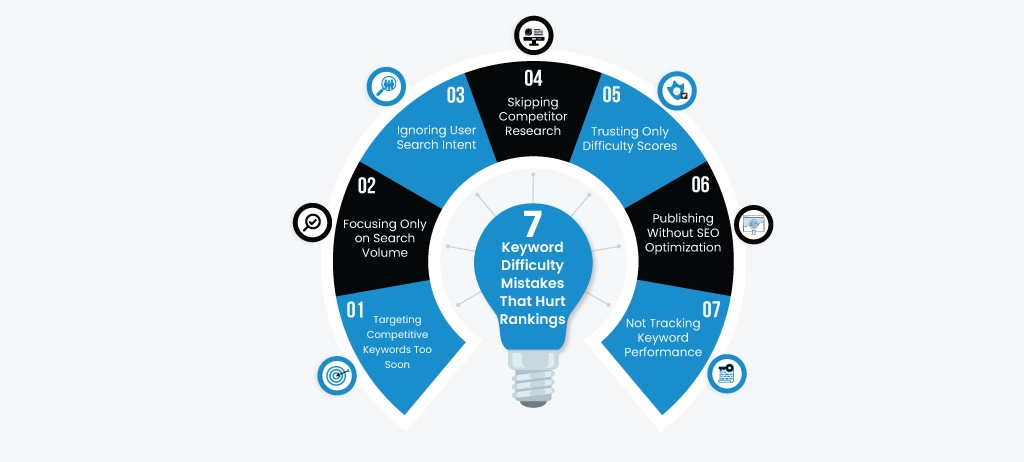
Checking keyword difficulty is an important part of keyword research, but it's only one piece of a successful SEO strategy. Many websites still struggle to rank because they make simple mistakes when selecting and evaluating keywords. Avoiding these mistakes can save you time, improve your content strategy, and help you achieve better rankings.
Here are some of the most common keyword difficulty mistakes to avoid.
1. Targeting High-Difficulty Keywords Too Early
Many beginners try to rank for broad, highly competitive keywords because they have the highest search volume. While these keywords can be valuable, they often require strong website authority, quality backlinks, and established topical relevance.
Instead, start with keywords that match your website's current authority and gradually work toward more competitive topics as your SEO performance improves.
2. Choosing Keywords Based Only on Search Volume
A keyword with thousands of monthly searches isn't always the best choice. If the competition is too high or the keyword doesn't match your audience's needs, it may never generate meaningful results.
Always compare search volume, keyword difficulty, and search intent before making your final decision.
3. Ignoring Search Intent
Even if you rank for a keyword, your content won't perform well if it doesn't answer what users are actually looking for.
For example, someone searching for a free keyword difficulty checker expects a tool or practical solution, not just a basic definition. Matching the user's intent improves both rankings and engagement.
4. Skipping Competitor Analysis
Many website owners choose keywords without reviewing the pages already ranking on Google.
Before creating content, analyze the top-ranking pages to understand what they cover, where they add value, and what opportunities you have to create something better. A website SEO analyzer and competitor analysis tools can help you identify content gaps and improve your strategy.
5. Relying Only on the Difficulty Score
Keyword difficulty is an estimate, not a guarantee.
A keyword with a moderate score may still be a great opportunity if your content is more useful, better structured, and supported by strong on-page SEO, technical SEO, and a positive user experience.
Always evaluate the complete picture before selecting a keyword.
6. Publishing Without Optimizing the Page
Choosing the right keyword is only half the job. If your page has weak headings, poor internal linking, slow loading speed, or technical issues, ranking becomes much more difficult.
Before publishing, review your page with a Website SEO Analyzer, improve your Core Web Vitals, and ensure your content follows on-page SEO best practices.
7. Never Monitoring Keyword Performance
SEO doesn't end after you publish an article.
Track your keyword rankings regularly to understand what's working and where improvements are needed. Monitoring performance helps you identify pages that need updates, optimize underperforming content, and measure the impact of your SEO efforts over time.
Most keyword ranking problems aren't caused by choosing the wrong keyword; they happen because the keyword is selected without considering the bigger picture. A successful SEO strategy combines keyword research, keyword difficulty, search intent, competitor analysis, website SEO analysis, and ongoing keyword rank tracking. When these elements work together, you're far more likely to create content that ranks consistently and drives long-term organic traffic.
How WRanker Helps You Analyze Keyword Difficulty
Choosing the right keyword becomes much easier when you have accurate SEO data in one place. Instead of switching between multiple tools, WRanker helps you analyze keywords, understand the competition, and make informed SEO decisions faster.
With WRanker, you can:
- Check keyword difficulty and compare multiple keyword opportunities.
- Discover related keywords with their search volume and ranking potential.
- Analyze your pages using the Website SEO Analyzer to ensure they're optimized for your target keywords.
- Improve page performance with the Core Web Vitals Checker and other technical SEO tools.
- Monitor your rankings over time with Keyword Rank Tracking to measure the impact of your SEO efforts.
Whether you're planning a new content strategy or optimizing an existing page, WRanker provides the insights you need to choose achievable keywords, improve your content, and grow your organic visibility with confidence.
Keyword difficulty is just one part of SEO. Combine it with keyword research, page optimization, technical SEO, and regular rank tracking to build a strategy that delivers consistent, long-term results.
Conclusion
Understanding keyword difficulty helps you make smarter SEO decisions before you invest time in creating content. Instead of chasing the most competitive keywords, focus on opportunities that match your website's authority, search intent, and business goals. By combining keyword research, competitor analysis, and the right SEO tools, you can choose keywords that are easier to rank for and drive sustainable organic traffic. Remember, successful SEO isn't about targeting every keyword; it's about targeting the right keywords.
Frequently Asked Questions
What is keyword difficulty in SEO?
How do I check keyword difficulty?
What is a good keyword difficulty score for beginners?
What is the best free keyword difficulty checker?
Why is keyword difficulty important in digital marketing?
Can a new website rank for high keyword difficulty keywords?
Does higher search volume mean a better keyword?
What should I analyze besides keyword difficulty?
How can WRanker help analyze keyword difficulty?
Should I choose keywords based only on keyword difficulty?
More Related Blogs: