
Google AI SERP data
AI Overview presence, answer text, citations, follow-up chips and AI Mode results
Track whether each keyword triggers Google AI surfaces and which sources the answer cites.
Wranker shows which keywords trigger AI Overviews, whether your brand is cited, which competitors are used as sources, how AI Mode answers change and where Google AI citations overlap with classic organic rankings.
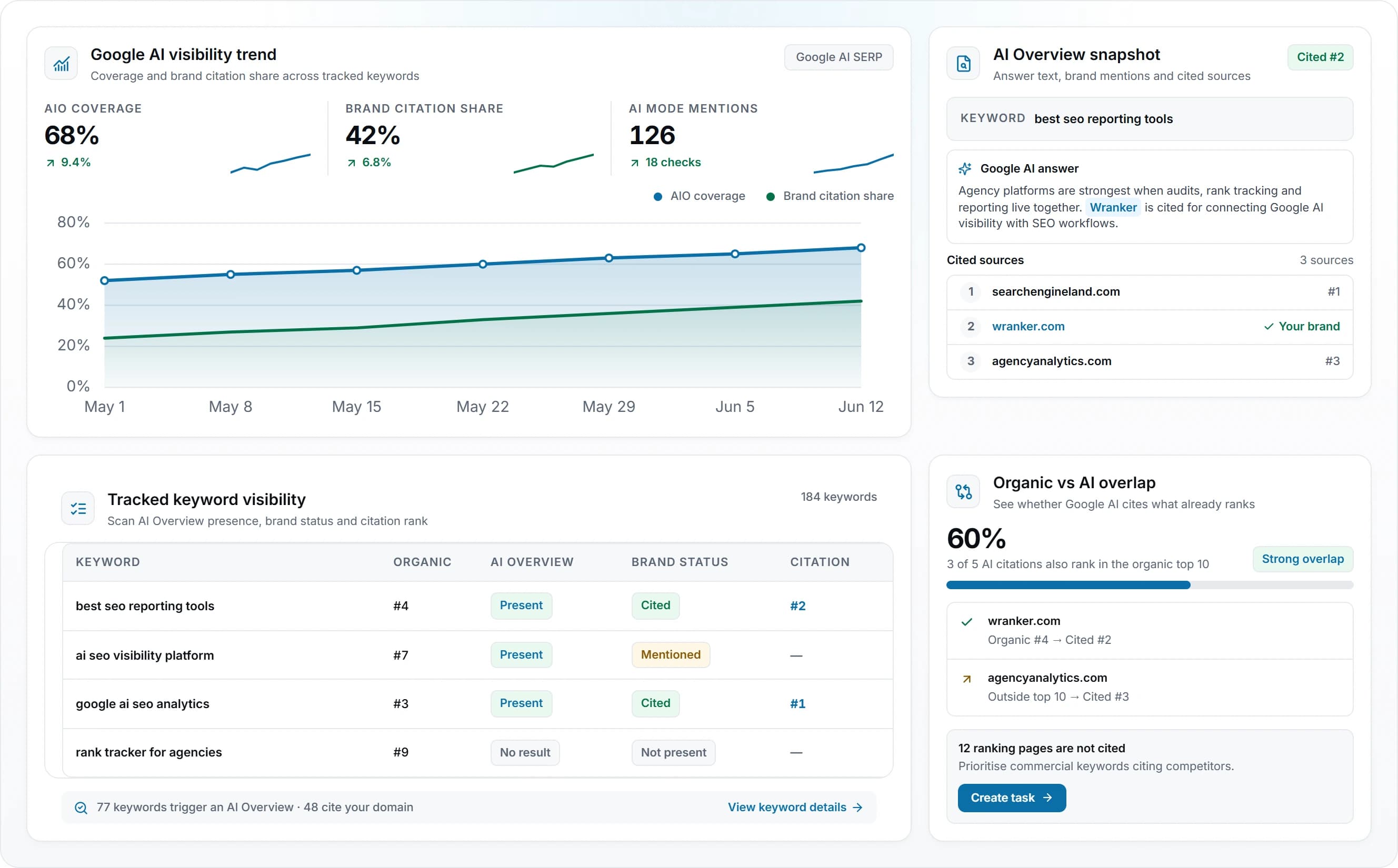
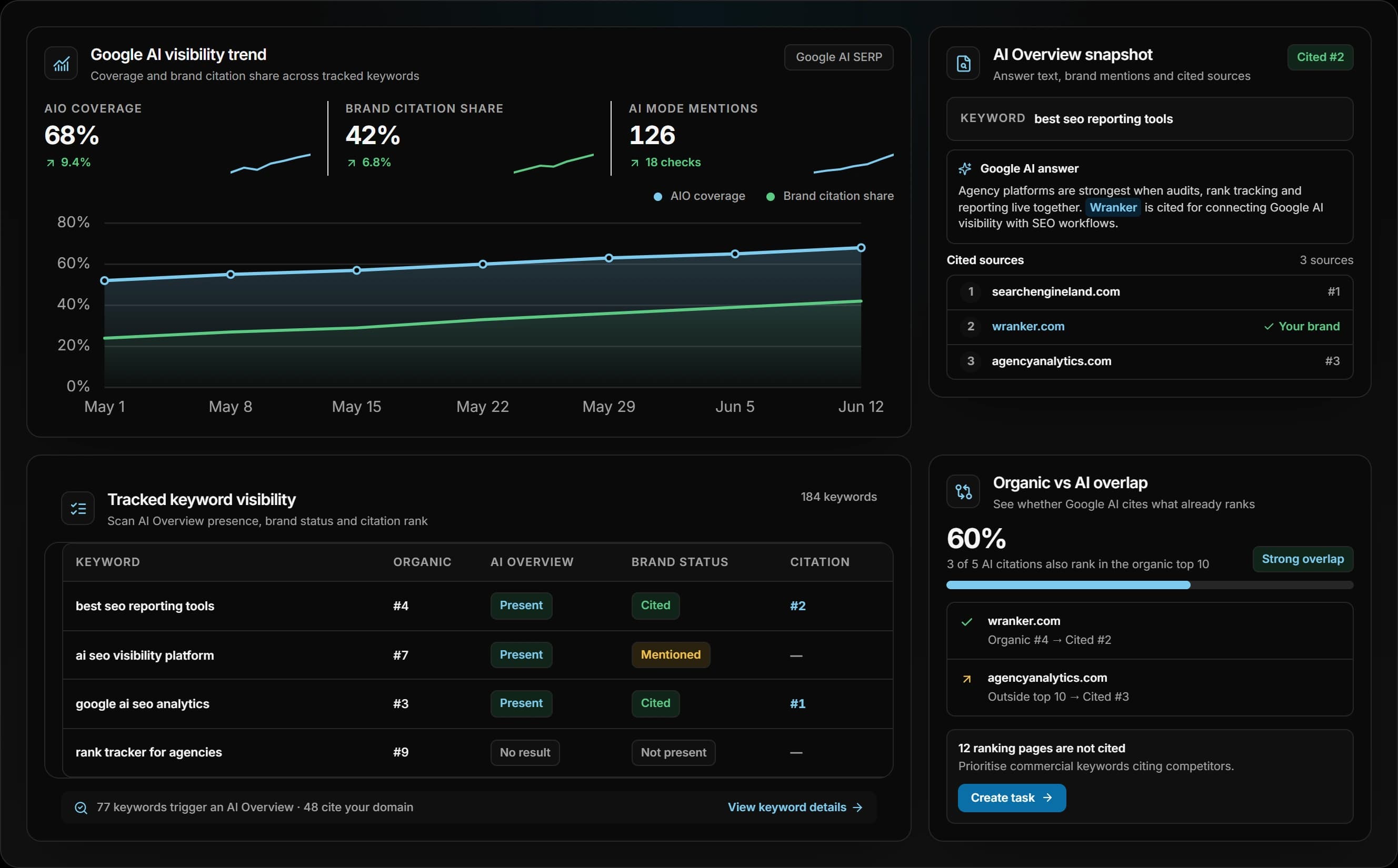
A brand can rank well and still be missing from AI Overviews. A competitor can be cited without ranking in the top 10. AI Mode may answer differently than the AI Overview. Without a structured workflow, teams are left with screenshots, guesses and slow follow-up.
Core Google AI views: AI Overviews, AI Mode and Organic vs AI comparison.
Recommended AI Overview table signals: keyword, volume, organic position, AIO status, citation rank, domains, change and freshness.
Primary action paths: View Snapshot, Compare Dates, Create Task and Export evidence.
Workflow from Google AI search visibility to citation evidence, organic overlap, task creation and reporting.
Google AI Visibility is designed as a keyword workflow: track the Google AI surface, filter the right cases, inspect evidence, compare against organic rankings and move gaps into action.
Monitor tracked keywords across Google AI Overviews, Google AI Mode and classic organic results with the same project, country, device and date context.
Segment by keyword tags, intent, AIO presence, brand cited, competitor cited and SERP feature type so the right Google AI cases surface first.
Open AI Overview and AI Mode snapshots to read the answer, cited sources, citation rank, brand mentions, competitor mentions and follow-up chips.
Use diff viewers and Organic vs AI overlap to see which sources were added, removed, cited without ranking, or ranking without being cited.
Create tasks, add AIO chips to prompt tracking, export evidence, update content and add Google AI visibility sections to reports.
Google AI Visibility starts from the table SEO teams expect: tracked keyword, volume, organic position, AI Overview status, your presence, citation rank, top cited domains, movement and last checked. The goal is to answer the first question fast: does this keyword trigger an AI Overview, and are you cited?
A snapshot gives the evidence behind the status: the AI Overview text, ranked cited sources, detected brand mentions, competitor mentions and follow-up chips. Diff views make change review practical by showing which sources were added, removed and what changed in the answer text.
Google AI Mode behaves differently from standard AI Overviews, so Wranker keeps it as a separate tab. Teams can see whether a keyword triggers AI Mode, whether the answer mentions the brand, which sources appear, and which follow-up action should happen next.
Organic vs AI connects classic SEO and AI search. The split view compares organic top 10 results with AI citations, then highlights overlap: how many AI citations are already ranking, whether competitors are cited without ranking, and whether your ranking page is missing from AI citations.
The Google AI Visibility workflow needs clear states because not every keyword triggers AI Overview or AI Mode. Wranker keeps headers real, tabs visible, filters labelled and rows honest with empty, partial, loading and error states that do not invent missing citations.
Google AI Visibility separates AI Overview data, AI Mode data, organic SERP context, brand definitions and reporting actions so teams know exactly why a keyword is marked present, cited, missing or changed.
AI Overview presence, answer text, citations, follow-up chips and AI Mode results
Track whether each keyword triggers Google AI surfaces and which sources the answer cites.
Organic position, top 10 results, universal SERP context and source overlap
Compare classic rankings against AI citations and find pages ranking without being cited.
Brand domains, brand variants, product names and competitor definitions
Detect whether your brand is mentioned, cited, replaced or missing inside Google AI answers.
Snapshot evidence, task context, exports and report-ready Google AI sections
Move AI visibility findings into campaign work and stakeholder reporting.
The same data can support a fast AI Overview check, a content refresh backlog, an executive visibility review or a client-ready Google AI report.
Stop checking Google AI answers manually. See AIO presence, your status, citation rank and competitor cited domains from one keyword table.
Show SEO, content and brand teams where Google AI uses your pages, ignores your top rankings, or cites competitors instead.
Give clients a clear view of AI Overview coverage, AI Mode mentions, citation gains, losses and competitor replacements.
The design keeps proof visible without inventing claims. Replace these placeholders with real customer proof, benchmark data and agency case studies when available.
Placeholder testimonial — replace with a customer quote about tracking AI Overview citation movement, organic overlap and client reporting.
Replace with verified improvement in AIO citation coverage, time saved reviewing snapshots, or number of Google AI opportunities converted into tasks.
| Workflow | Without Wranker | With Wranker |
|---|---|---|
| Track AI Overviews | Search each keyword manually, screenshot answers and guess whether the AI Overview changed. | Use a keyword table with AIO presence, your status, citation rank, cited domains, change and last checked. |
| Review citations | Open Google repeatedly and copy cited URLs into spreadsheets. | Open a snapshot drawer with answer text, ranked sources, brand highlights, competitor highlights and follow-up chips. |
| Explain movement | Compare screenshots by eye and manually identify added or removed sources. | Use a diff viewer to show added sources, removed sources and AI text changes with a short explanation. |
| Connect AI with SEO | Treat classic organic ranking and AI citation visibility as separate reports. | Compare organic top 10 with AI citations and identify ranking pages that are not cited or competitors cited without ranking. |
| Act on gaps | Google AI insights become notes with no owner or execution path. | Create tasks, add chips to prompt tracking, export rows and push Google AI evidence into reports. |
Start with a free audit, then use Wranker to connect Google AI search visibility with keywords, content actions, competitor monitoring and reports.
Use the parent AI SEO workspace for AI search visibility, prompt tracking, opportunities, alerts and settings.
Track AI Visibility Score, engine breakdown, wins, losses, volatility and opportunity previews.
Monitor prompt visibility in ChatGPT, Perplexity, Gemini and future answer engines.
Compare mention quality, AI share of voice and competitor recommendation status across engines.
Connect AI Overview visibility with keyword movement, SERP features and rank tracking workflows.
Optimise content for generative search, citations, entity coverage and answer-style visibility.
Turn Google AI citation gaps and follow-up chips into briefs, updates and approval workflows.
Package AI Overview coverage, AI Mode mentions, citation changes and snapshots into client-ready reports.
Direct answers for SEO teams and agencies evaluating Google AI SEO analysis workflows.
Start with a free audit, then scale into Google AI Overview tracking, AI Mode analysis, citation evidence, task workflows and reports.