
Local SERP and Google Map data
Map Pack presence, ranking position, local business competitors, device and location-specific result changes.
Map Pack tracking
Wranker’s Local SEO Rank Tracker shows Map Pack coverage, grid rank, local keyword movement, city and ZIP performance, competitor changes and action-ready rank alerts from one connected workspace.
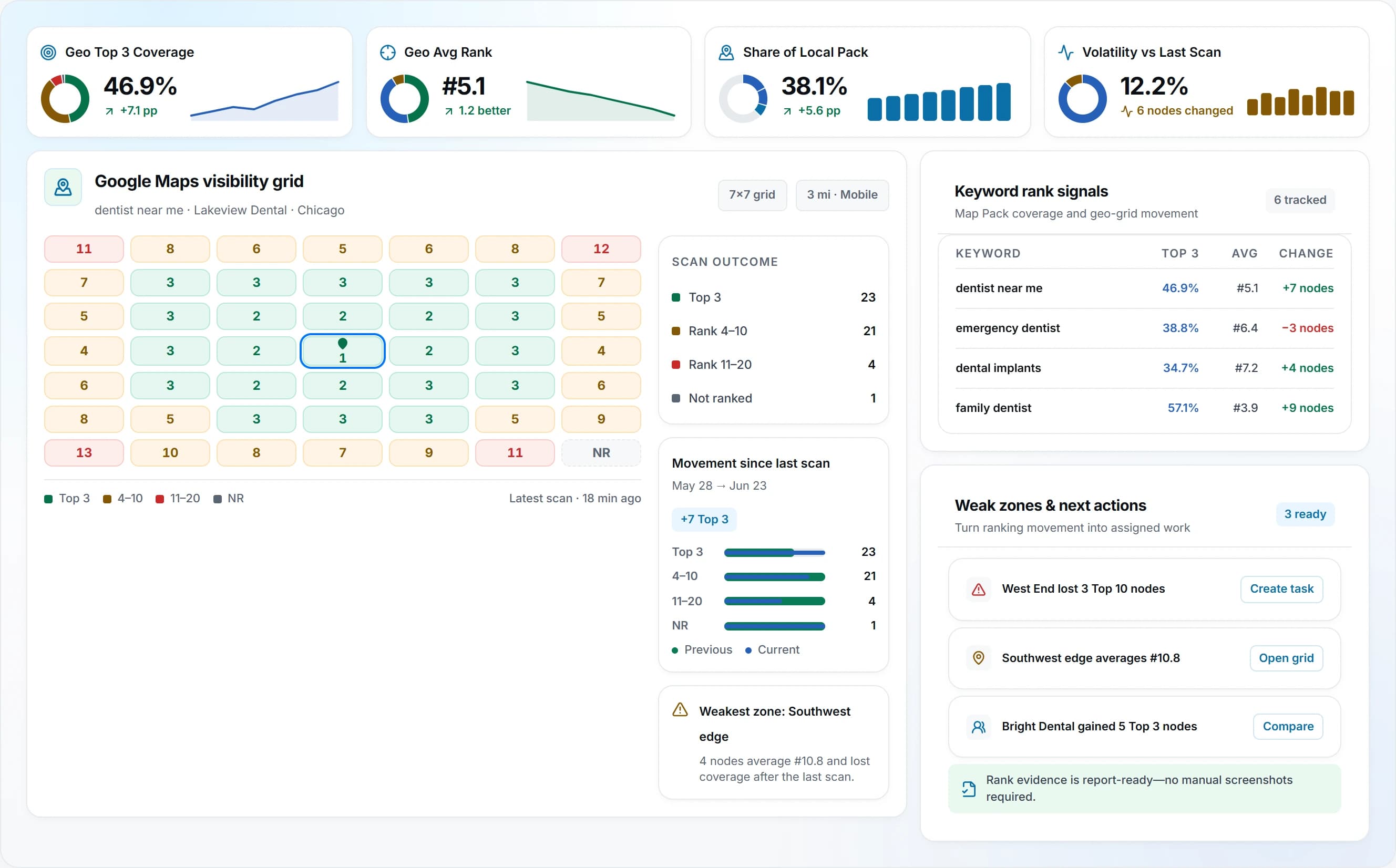
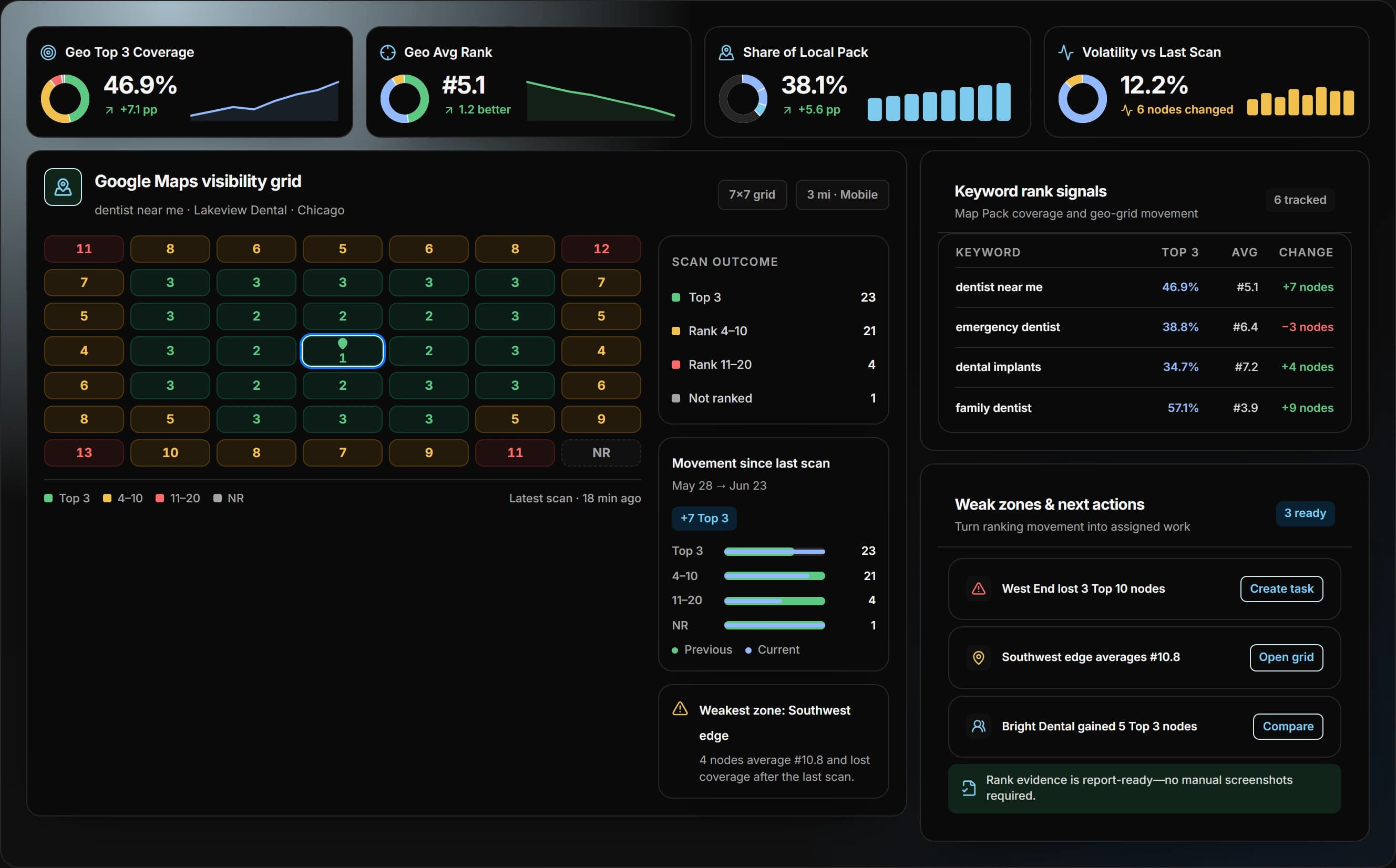
A business can rank near the storefront, disappear three blocks away, regain visibility in one ZIP, and lose the Map Pack to a competitor in another service area. A single rank position cannot explain that.
Core rank views modelled for the feature: Map Pack, Grid Rank, Keywords, Competitors and Alerts.
Local ranking KPIs: Map Pack Coverage, Average Grid Rank, Best Node, Top 3 Nodes, Competitor Entries and Open Rank Tasks.
Action paths from rank evidence: Create Task, Add to Report, Export and open connected GBP, review or citation workflows.
One workspace for agencies and teams tracking one storefront, many branches or multi-client local SEO campaigns.
Figures illustrative — swap for verified benchmarks.
Wranker treats local rank tracking as an operating workflow: define the search area, monitor Map Pack and grid movement, compare competitors, diagnose the likely cause and turn evidence into tasks or reports.
Choose locations, service areas, keywords, search radius, grid size, city or ZIP filters, device and tracking cadence before rank data starts flowing.
Monitor Map Pack coverage, average grid rank, best node, local keyword movement and ranking changes across each branch or service area.
See which nearby competitors entered the pack, improved their grid coverage or overtook your best local ranking zones.
Connect ranking drops to GBP freshness, review momentum, citation issues and local landing page opportunities so the next action is clear.
Create tasks, add rank evidence to reports, export CSV/PDF views and show stakeholders what changed without rebuilding screenshots.
Start with the rank table local SEO teams expect: keyword, intent, Map Pack presence, your position, average grid rank, movement, best location and last checked. Wranker makes ranking status clear before anyone opens a separate grid export.
Grid rank tracking shows the spatial reality of local search. Instead of one average rank, teams see node-by-node map visibility, weak zones, best nodes and Top 3 coverage around a business location or service area.
Local visibility is not uniform. Wranker keeps location context visible with city and ZIP filters, branch groups, service areas, radius controls, mobile or desktop views and date comparisons for multi-location teams.
Local rankings are competitive at the node level. Wranker shows which competitors entered the pack, where they gained grid coverage, which keywords they dominate and what evidence supports the change.
Rank tracking should not end as a chart. Wranker routes drops, lost nodes, competitor gains and weak zones into tasks, report sections and local recommendations connected to GBP, reviews, citations and local pages.
Wranker’s local rank tracking model keeps map rank data, grid scans, keywords, GBP context, reviews, citations, tasks and reports connected without hiding where each signal came from.
Map Pack presence, ranking position, local business competitors, device and location-specific result changes.
Map Pack tracking
Node-level ranking position, best node, weak zones, radius coverage, average grid rank and Top 3 visibility.
Grid Rank
Near-me keywords, service keywords, branded queries, city pages, service-area tags and rank movement segments.
Local Keywords
Categories, services, hours, posts, photos, Q&A and profile freshness signals that explain local ranking opportunities.
GBP diagnosis
Rating movement, review volume, response status, NAP consistency, duplicate listings and citation coverage context.
Local ranking context
Create Task, Add to Report, Export, owners, due dates, white-label report sections and shareable evidence.
Execution workflow
Local rank tracking has different jobs depending on the operator: quick audits, branch-level diagnosis, portfolio delivery or client reporting. Wranker keeps the workflow flexible without splitting the evidence.
Move beyond a single manual search. See keyword position by radius, node, city and location so local ranking work starts with evidence.
Give SEO, local marketing and operations a shared view of where rankings moved, which locations are exposed and which actions should happen next.
Run repeatable local rank tracking across client portfolios and turn map-grid evidence into white-label reports and task workflows.
Placeholder testimonial — replace with customer proof about using Wranker to diagnose map ranking drops, competitor movement and local SEO task priorities.
Replace with a verified benchmark such as faster rank review time, more local ranking issues converted into tasks, or improved Map Pack coverage.
Wranker connects rank evidence to local SEO diagnosis, execution and reporting so the team does more than watch red and green squares change.
| Workflow | Without Wranker | With Wranker |
|---|---|---|
| Check map rankings | Search manually from one location, screenshot Google Maps and miss how rankings shift across nearby neighborhoods. | Track Map Pack coverage, grid rank, best node and location-specific ranking movement from one local rank dashboard. |
| Understand rank drops | A rank grid shows a red patch, but the team still guesses whether GBP, reviews, citations or competitors caused the change. | Wranker connects rank movement to local signals and recommended actions so ranking issues become fixable work. |
| Compare competitors | Competitor movement is checked by hand and rarely tied to specific cities, ZIPs, nodes or keywords. | Competitor panels show who entered the pack, where they gained coverage and which keywords need attention. |
| Manage multi-location rank tracking | Each branch needs separate exports, separate screenshots and separate client notes. | Locations roll up into one workspace with branch filters, city or ZIP views, keyword groups and report-ready sections. |
| Report local ranking progress | Teams rebuild monthly reports by copying grid exports, rank tables and screenshots from multiple tools. | Rank grids, keyword wins, ranking drops, competitor changes and completed tasks can be added to reports directly. |
Start with a free audit, then use Wranker to connect local rank tracking with GBP improvements, citation fixes, review work, competitor monitoring and reports.
Map rank data becomes more valuable when it connects to GBP, listings, reviews, tasks, reporting and agency workflows.
Use the parent local SEO workspace for GBP health, listings, reviews, local rank tracking, insights, tasks and reports.
Connect ranking movement with profile completeness, categories, services, posts, photos, Q&A and GBP freshness.
Investigate whether NAP mismatches, duplicates or missing citations are weakening local ranking trust.
Connect map ranking changes with review volume, rating movement, sentiment themes and response SLAs.
Package map rankings, grid movement, keyword wins, competitor changes and tasks into client-ready reports.
Add rank grids, Map Pack coverage, location summaries and recommendations to custom report templates.
Turn ranking drops, lost nodes and competitor wins into assigned work with owners, due dates and validation status.
Manage local rank tracking delivery across clients, teams, roles, projects and white-label reporting workflows.
Direct answers for SEO teams and agencies evaluating Google Map Rank Tracker Tool workflows, grid rank tracking and local reporting.
Start with a free audit, then use Wranker to monitor Google Map rankings, grid rank movement, competitors, tasks and reports from one connected workspace.